Short answer: Jellyfish can be found in Krabi’s waters at any time of year, so there is no fully safe month. The risk from box jellyfish and other venomous species is generally higher during the rainy season, roughly May to October, especially after storms and strong onshore winds. Box jellyfish have been reported around Krabi’s beaches and islands, including Noppharat Thara, the Phi Phi islands and Koh Lanta. Serious stings are rare.
If someone is stung: get them out of the water, call 1669 if they have trouble breathing or collapse, pour vinegar over the sting for at least 30 seconds, and do not rub the skin.
When is jellyfish season in Krabi?
Thailand does not have a single, fixed jellyfish season. Different species appear at different times, and sightings depend on wind, currents and water temperature. As a general guide:
| Period | Conditions | What to expect |
|---|---|---|
| May to October (rainy season) | Southwest monsoon, rougher sea, onshore winds | Higher chance of venomous jellyfish near the shore, particularly after storms. Thai authorities usually issue jellyfish warnings in this period. |
| November to April (high season) | Calmer sea, clearer water | Lower risk overall, but stings still occur, partly because many more people are swimming. |
Because conditions change from week to week, the most reliable guide is local information on the day: warning signs, flags, lifeguards and hotel staff.
Which beaches in Krabi?
Box jellyfish and other venomous species have been reported along the Andaman coast, including Krabi’s mainland beaches and islands. Areas mentioned in official warnings include Noppharat Thara, the Phi Phi islands and Koh Lanta. This does not mean these beaches are unsafe; it means jellyfish can drift into any part of the coastline.
- Ao Nang and Noppharat Thara: busy, easily reached beaches. Look for warning signs and vinegar stations.
- Railay and Phra Nang: reached by boat. Help is available at SOS Railay Clinic, inside Railay Bay Resort & Spa.
- Phi Phi, Hong and other islands: on day trips, ask your boat operator whether vinegar is on board.
- Koh Lanta: long, open beaches. Check local warnings before swimming.
How dangerous are box jellyfish?
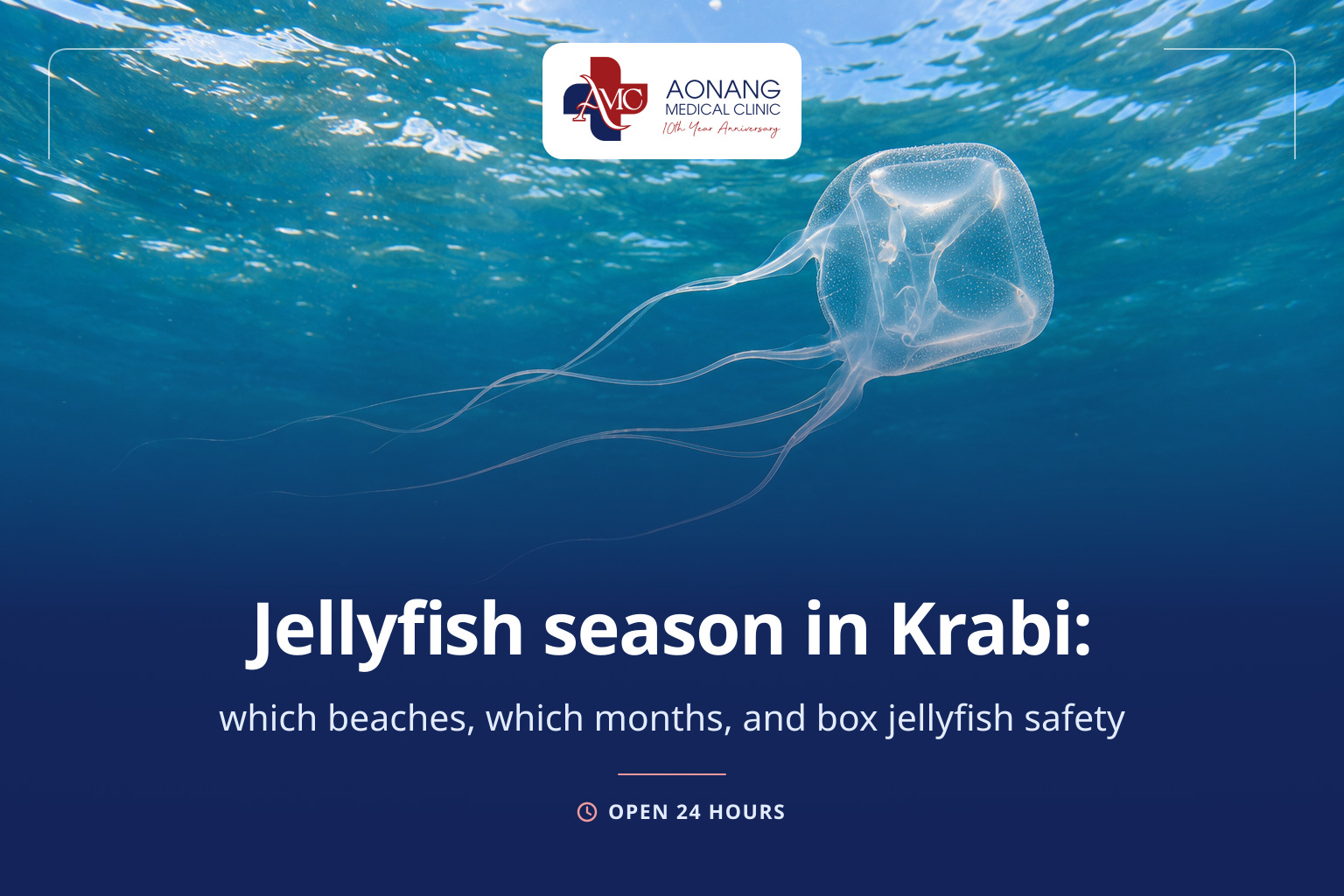
Box jellyfish are almost transparent, have a cube-shaped body and long tentacles, and are hard to see in the water. Most jellyfish in Thailand cause only a painful, local sting. Box jellyfish are different: a large sting can cause severe pain, breathing difficulty, heart rhythm problems and, rarely, death. Fatal stings have been recorded in Thailand, including in Krabi province, but they remain uncommon.
Children are at greater risk because the same amount of venom affects a smaller body.
Vinegar stations on the beach
Many beaches in southern Thailand have first aid stations: tall posts holding a bottle of vinegar with instructions. Vinegar stops undischarged stinging cells on box jellyfish tentacles from firing. When you arrive at a beach, take a moment to note where the nearest station is.
Stations are not on every beach, and bottles can be empty. If you are going somewhere remote, carry your own.
What to pack for the beach
- A small bottle of household vinegar
- A long-sleeved rash guard or thin full-body swimsuit (a “stinger suit”) for snorkelling
- Gloves or tweezers to remove tentacles
- Your phone, with the clinic number saved: +66 93 149 6554
Stung by a jellyfish: what to do
- Get out of the water and call for help. Keep the person still.
- Check breathing. If the person has difficulty breathing, chest pain, confusion or collapses, call 1669 for an ambulance. Start CPR if they are not breathing normally.
- Pour vinegar generously over the sting for at least 30 seconds if a box jellyfish is possible.
- Remove any remaining tentacles with gloves or tweezers after applying vinegar.
- Ease the pain. For most non-box jellyfish stings, soaking in hot water that is comfortable to the touch for about 20 minutes can help.
- See a doctor for any sting that is large, very painful, near the eyes or face, affects a child, or causes symptoms beyond the skin.
What not to do
- Do not rub the area with sand, a towel or your hand.
- Do not rinse with fresh water, which can trigger more stinging cells.
- Do not use urine, alcohol or ice applied directly to the skin.
For full treatment details, see our page on jellyfish and sea urchin stings. If your rash appeared hours after swimming and only under your swimsuit, it may be sea lice instead. Read sea lice vs jellyfish.
Stung in Ao Nang or Railay?
Aonang Medical Clinic in Ao Nang is open 24 hours. In Railay, go to SOS Railay Clinic at Railay Bay Resort & Spa, or call 065 093 9554. For Ao Nang, call or WhatsApp +66 93 149 6554. In an emergency, call 1669.
Frequently asked questions
What month is jellyfish season in Krabi?
Jellyfish can appear year-round, but the risk from venomous species is generally higher in the rainy season, roughly May to October, especially after storms and strong winds.
Are there box jellyfish in Krabi?
Yes. Box jellyfish have been reported along the Andaman coast, including Krabi’s beaches and islands. Serious stings are rare, but swimmers should know where vinegar is available.
Is it safe to swim in Ao Nang?
Swimming in Ao Nang is generally safe. Follow local warnings and flags, avoid swimming after storms when jellyfish warnings are in place, and know the location of the nearest vinegar station.
Does vinegar work on all jellyfish stings?
Vinegar is recommended for box jellyfish. For many other stings, hot water immersion is more helpful for pain. If you are unsure of the type, vinegar is the safer first step in Thailand.
Should I see a doctor after a jellyfish sting?
See a doctor for large or very painful stings, stings on the face or near the eyes, any sting on a child, or any symptoms such as breathing difficulty, chest pain, vomiting or confusion.